You have decided to sell your business in Dubai, but you don't want employees, customers or competitors to find out yet.
At first, the answer seems simple: remove the company's name, logo and exact address from the listing. But what do you publish instead?
Buyers want photographs—yet the interior may identify your café immediately. They need to know the neighbourhood, seating capacity and rent—but those details, taken together, may give you away even without a name. Hide everything, on the other hand, and you're left with another unhelpful listing saying “Profitable business for sale in Dubai.”
How can you attract a genuine buyer without telling everyone which business you own? And when is it safe to reveal more?
Confidential selling is not about hiding information for its own sake. It is about choosing the right moment to share it.
Give buyers enough to become interested
In professional M&A, an anonymous description of an acquisition opportunity is often called a blind teaser. It leaves out information that could identify the seller while helping a buyer decide whether the opportunity is worth discussing.
But a good teaser must still say something meaningful.
Imagine you own a restaurant in Dubai. A prospective buyer needs to know what sort of operation is on offer. You can explain that it serves a business district near office buildings; has approximately 40–60 seats; attracts repeat guests and corporate catering or event orders; and generates revenue through dine-in, delivery and corporate business. You may give broad ranges for daily sales, staffing and rent, provided the combination does not identify the venue.
Established Restaurant for Sale in Dubai
Operating restaurant in an active Dubai business district. Approximately 40–60 seats, a team of 10–15, and average daily sales of AED 7,000–10,000. Revenue comes from dine-in customers, delivery and corporate orders. Fully equipped and operating normally. Additional details are available confidentially to interested buyers.
All figures above are hypothetical.
This tells a buyer the approximate scale and business model. It does not give away the restaurant's name.
Still, context matters. If only one restaurant in that part of the city fits the description, even ranges may reveal too much. A recognisable staircase, mural or terrace in a photograph can point directly to a Google Maps or Instagram page.
You could publish cropped, genuinely non-identifying photographs or clearly labelled illustrative visuals. Never present a photograph of somebody else's premises as if it were the restaurant you are selling.
Your first job is to sell interest in the opportunity—not disclose your company's identity.
Interest first, introductions next
Not everyone who asks for details is ready to acquire a company. That is true. Some people are comparing opportunities. Others are only beginning to think about owning a business.
And that is normal.
The opening conversation should not feel like an interrogation. A buyer who barely knows what is being offered has little reason to provide bank statements, reveal their financing or discuss their maximum budget.
Start with the business. Explain its operating model, the type of customers it serves, the sources of revenue, the broad cost structure, what makes it attractive and why the owner is considering a sale. Avoid names, identifiable client details and sensitive documents for now, but give the other person enough substance to decide whether to keep talking.
If interest continues, two simple questions help:
Questions about the ability to fund an acquisition matter later—when a proposal becomes concrete and you are considering exclusivity or extensive disclosure. They need not dominate the first conversation.
The aim at this stage is a useful business discussion and a little mutual trust.
Make the NDA a natural next step
Suppose the conversation goes well. The prospective buyer understands the broad economics, asks sensible questions and wants the trading name, exact location, detailed accounts or contracts.
That is a reasonable moment to explain the stakes. The company is still operating. Employees, customers, suppliers and the landlord may be affected if rumours spread before a transaction is even likely.
A straightforward explanation is enough:
“Thanks for your interest. The business is operating normally and we have responsibilities to our employees, clients and partners. We are therefore keeping the discussions confidential at this stage. If you would like to continue, let's put a standard non-disclosure agreement in place. We can then share the company's identity and review the figures in more detail.”
This does not accuse anybody of bad intentions. It signals that you are handling the process responsibly.
Have the NDA prepared before marketing the business. Ask a UAE-qualified lawyer to draft a clear template that can be completed with the other party's correct details and signed by an authorised person. A reasonable buyer should be free to read it and discuss practical changes.
The NDA should address permitted use of information; who may see it; confidentiality of the negotiations themselves; restrictions on contacting staff, clients, suppliers or the landlord about the sale without permission; misuse of commercially sensitive information; and the return, deletion or lawful retention of documents if talks end. Duration, governing law, remedies and enforceability need professional review.
An NDA does not prevent every leak. It establishes the rules and makes the transition from an informal enquiry to substantive negotiations explicit.
An NDA is not a key to every file
Signing a confidentiality agreement does not mean the buyer should immediately receive your full accounting records, customer database and CRM login.
A sensible confidential sale uses progressive disclosure. The details vary by transaction, and information material to a buyer's decision may need to be disclosed earlier, but the general approach is useful.
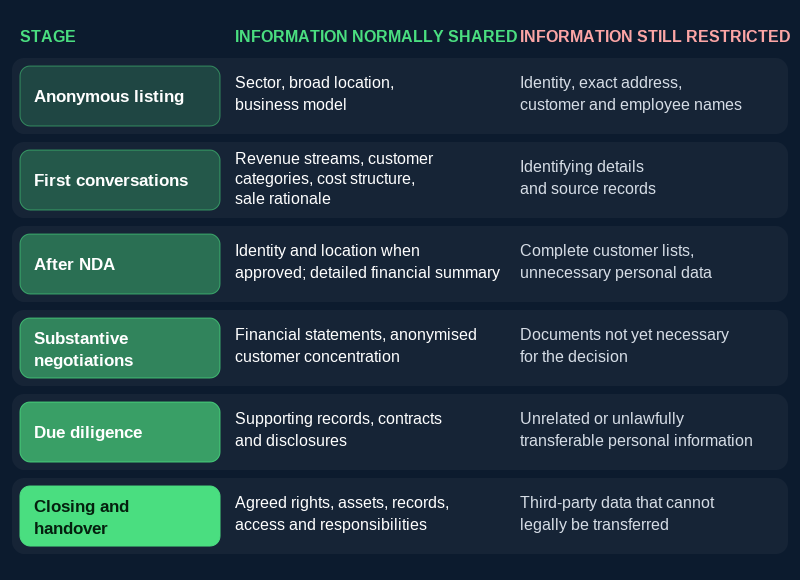
| Stage | Information normally shared | Information still restricted |
|---|---|---|
| Anonymous listing | Sector, broad location, business model, indicative operating and financial ranges | Identity, exact address, customer and employee names |
| First conversations | Revenue streams, customer categories, cost structure, sale rationale | Identifying details and source records |
| After NDA | Identity and location when approved; more detailed financial summary and operational information | Complete customer lists, unnecessary personal data |
| Substantive negotiations | Financial statements, anonymised customer concentration, major obligations, management structure | Documents not yet necessary for the decision |
| Due diligence | Supporting records, contracts and disclosures within controlled access | Unrelated or unlawfully transferable personal information |
| Closing and handover | Agreed rights, assets, records, access and responsibilities | Third-party data that cannot legally be transferred |
For instance, if your largest customer generates 45% of revenue, the buyer needs to know that concentration risk. The customer's identity may be disclosed later through a controlled process.
Do not conceal material facts. Do not circulate sensitive details before they are needed. Both principles can coexist.
Show the economics without exposing the entire business
A serious buyer must be able to verify revenue, costs and earnings. Otherwise, there is no sound basis for an offer.
Yet imagine selling a cleaning business to a company in the same industry. Your contracts reveal client names, individual rates, renewal dates and discounts. That information could be commercially useful to the competitor even if talks collapse.
Prepare financial information at several levels. Begin with monthly revenue, operating profit, main expense categories, contract counts and anonymised client concentration. Replace individual employee records with payroll totals and job categories. Later, give qualified reviewers appropriate access to source documents rather than emailing everything indiscriminately.
An independent accountant can reconcile sales to underlying records and present findings without exposing unrelated private transactions. Restricted-access document rooms are especially useful when the interested party is a direct competitor.
Remember that an NDA is not, by itself, a legal basis to disclose personal information. Employee files and customer databases require appropriate safeguards under the relevant UAE or free-zone data protection rules.
Let them see the business without starting rumours
Eventually, a prospective buyer will want to visit a restaurant, salon, shop or gym. That is a perfectly reasonable request.
But imagine a stranger touring the premises, taking pictures of the till, questioning the team about sales and asking the manager how long the owner has been involved. Staff may suspect a sale long before an offer exists.
Agree on the rules before any visit. For a restaurant, a first encounter may simply be an ordinary lunch or dinner: the buyer can experience service, atmosphere and customer traffic without turning the visit into an inspection.
There is no reason to invent a false story or ask employees to lie. If the buyer needs to examine the kitchen, inventory, equipment or back-of-house areas, organise a separate controlled visit at an appropriate time.
The NDA and visit protocol should prohibit unapproved staff interviews, photographs of restricted areas and direct approaches to customers, suppliers and landlords about the potential sale. As the transaction advances, some people will need to be informed—but according to a deliberate plan, not through gossip.
A competitor requires more care, not an automatic rejection
Sometimes a competitor is the most credible buyer. It knows the market and may gain value from your customer relationships, location, team or contracts.
The challenge is what you reveal during negotiations. A competitor might ask for customer-specific prices, procurement terms or salary details long before those records are essential to its decision.
At the early stages, aggregate and anonymise. For a larger transaction, independent lawyers or accountants may review sensitive material and report the conclusions. Where appropriate, a clean team can separate diligence from the competitor's operating decision-makers, with specialist competition-law advice.
The objective is to make a transaction possible without leaving the seller exposed if it does not happen.
Confidentiality is not permission to hide bad news
There is a difference between protecting commercial secrets and withholding facts that could materially change a purchaser's decision.
Perhaps a major client has announced that it will not renew. Perhaps the landlord has confirmed a substantial rent increase. Perhaps new sector rules will require expensive upgrades.
You can control the timing and secure handling of supporting documents. You cannot assume you can conceal the underlying risk until closing.
The UAE's new Civil Transactions Law, enacted through Federal Decree-Law No. 25 of 2025 and effective from 1 June 2026, addresses good-faith negotiations, disclosure of material information in specified circumstances and the misuse of confidential information in Articles 121–123. Applicability depends on the governing law, jurisdiction and transaction facts, so UAE legal advice remains essential.
Protect the company's secrets. Be candid about material problems.
Put one professional in charge of disclosure
You do not have to manage every NDA, file request and buyer conversation personally.
For a serious process, appoint a responsible professional. A lawyer can oversee agreements and confidentiality rules; an accountant can prepare and verify financial information; and a deal adviser or designated coordinator can organise requests and communications.
A small sale does not require a costly institutional system. Sometimes a named person, a well-structured folder with access controls, a prepared NDA and a disclosure log are sufficient.
The important points are simple: know who approves access, what each candidate has received, which documents are restricted and when permissions should be withdrawn.
Professional handling can reassure buyers that the process is serious and consistent. It also discourages casual circulation of documents simply because a file happens to be available.
You might not need a public listing at all
So far, we have talked about protecting a company's identity in a public advertisement. But what if the company were never advertised publicly?
A profitable group of cafés might be relevant to existing restaurant operators, specialist entrepreneurs or owners of adjacent businesses. They may have no idea an acquisition is possible until someone approaches them privately.
In an off-market sale, the owner or adviser builds a targeted list of prospective buyers and approaches them on a confidential basis. That requires thoughtful buyer research; it does not guarantee that someone will be interested. The same disclosure precautions still apply, especially when approaching competitors.
SHARH's approach is to understand the company's economics, distinctive strengths and the kinds of people or businesses that might want to own it. Structured information can support relevant buyer matching. SHARH's Find My Buyer offering is designed around targeted identification and outreach to prospective buyers; in some cases, a public advertisement need not be the starting point.
A sale cannot remain secret forever
Closing may require corporate filings, bank KYC changes, licence approvals, contractual consents and operational handover. Depending on the deal, employees, landlords, clients or regulators may need to know.
Plan who will communicate what, to whom and when. Perhaps key employees should meet the buyer before closing; perhaps an important customer requires a joint introduction. A coordinated announcement is usually better than surprise rumours.
The goal is not permanent secrecy. It is to retain control over disclosure until the business can safely move to its next owner.
The right amount of information at the right time
Buyers will not purchase a company blindly. They need real information about earnings, obligations and prospects. Excessive secrecy can drive credible buyers away; unrestricted disclosure can damage the company before a deal exists.
Begin with a useful anonymous description. Have a normal business conversation. When interest becomes mutual, use an NDA and progressively share more. Control document access, organise diligence and plan the handover.
A good confidential sale is not one in which the buyer knows nothing. It is one in which the buyer has enough information for the next decision without creating unnecessary risk for the business.
And sometimes the best confidential sale does not begin with a public advertisement at all.
Common questions
Can I sell a business in Dubai without revealing its name?
You can initially market an opportunity anonymously, provided the facts are accurate and the business cannot readily be identified. A serious purchaser will eventually need adequate information for diligence, and legal disclosures cannot simply be avoided.
Should an NDA be signed before revealing the company name?
Often, yes. The timing depends on what is already public, the sensitivity of the information and the buyer's legitimate needs. The NDA must be suitable for the jurisdiction and transaction.
Can I include photographs in an anonymous listing?
Only if you have the right to use them and they do not reveal the business. If photographs are illustrative rather than pictures of the actual premises, label them honestly.
Can I keep the sale from my employees?
You may be able to limit early knowledge, but legal duties, transfer arrangements and the practical handover can eventually require consultation, disclosure or other action.
What if the buyer breaches the NDA?
Preserve evidence, restrict further access where appropriate and consult UAE legal counsel. The remedies depend on the contract, facts and governing law.
- 01UAE Civil Transactions Law (official text, Articles 121–123)
- 02SHARH — About / private, NDA-gated process
- 03SHARH — Exit readiness checklist
- 04Mayer Brown — pre-contract disclosure under the new UAE Civil Code
This guide is general information, not legal advice. The transaction structure and the relevant mainland or free-zone rules should be checked with qualified advisers.